Ruth Duffy, Healthcare and the Troubles: The Conflict Experience of the Northern Ireland Health Service, 1968-1998 (Liverpool UP, 2024)
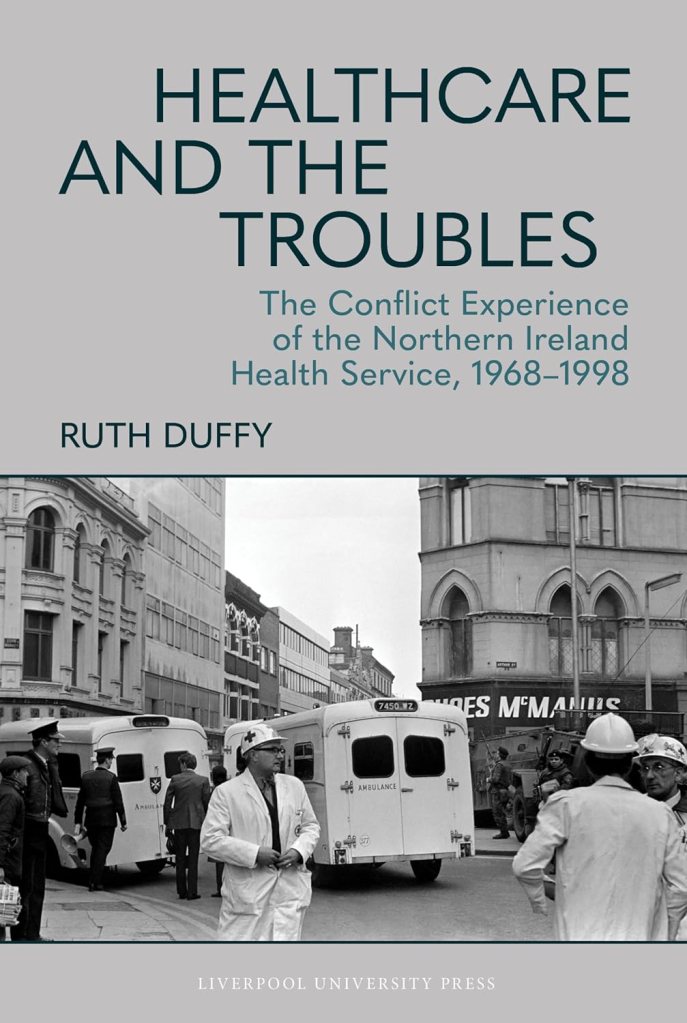
Welcome on behalf of Institute of Irish Studies to this afternoon’s book launch of Ruth Duffy’s, Healthcare and the Troubles: The Conflict Experience of the Northern Ireland Health Service, 1968-1998. It’s my honour and great pleasure to be able to introduce this important a timely new book to you and suggest why I believe it will make such a significant contribution to our understanding of the period of civil conflict we label the NI Troubles.
It’s unnecessary to remind an audience here in Belfast of the traumatic impact of our conflict that stretched over three decades from the Civil Rights marches of 1968 to the Good Friday Agreement and Omagh bombing of 1998, and which continues to cast a long shadow of unresolved legacy issue to the present. Political violence took 3700 lives and, at a conservative estimate, left over 40,000 physically injured, in a small society in which atrocity and counter-atrocity was intimate and neighbourly, a security infrastructure was pervasive and the rhythms of ordinary life disrupted and punctuated by fear and terror.
We of course now have an enormous academic literature on the conflict from multiple disciplinary perspectives. Remarkably, however, given that traumatic death, injury and lasting physical and mental scarring were at the heart of Troubles experience, scholarly discussion of its impact on the health service and its professionals has been minimal. Until now. Ruth Duffy’s new book is the first to offer an overview of how the health service in the north was structured and prepared (or rather unprepared) for the storm that would break in the late 1960s; how it responded to the sudden and extreme upsurge of violence in the following years; how the concepts of medical ‘neutrality’ and ‘impartiality’ and medical ethics more generally were challenged by the upheaval; and how both practitioners and the general public were impacted at the time and retrospectively by the stresses and traumas of violence and its legacies. To address the challenge, she has adopted complementary historical methods, working patiently through the ministerial records and reports concentrated in PRONI, press coverage over an extended period, and added a series of structured oral history interviews with medical staff from hospitals and community practices across the province.
The devolution of health policy to the Northern Ireland government from 1921 meant that the history of health provision, and from 1948 of the NHS, in the north overlaps with but was never identical to the rest of the UK (which may explain its omission from many general histories of the NHS). Throughout the 20th century, NI tended to top the tables for indicators of poor public health, interconnected with its high levels of structural inequality, poverty and substandard housing. These underlying challenges, combined with the absence of effective planning for the sort of civil emergency that would manifest from August 1969 meant its health institutions were already under significant strain when that happened. With limited additional funding until 1972 it was remarkable that the system coped at all, due largely to the dedication and commitment of its health professionals.
The book does not shy away from the profound problems of a medical system maintaining a real and perceived ‘neutrality’ amid conditions of acute communal polarisation and struggles for control of physical space. These posed major challenges to both the aspirations to maintain medical ‘immunity’ from violence and ‘impartiality’ in the provision of care under conditions of insurgency. Nominally medical provision should be legally protected under the Geneva conventions, but in NI conditions this was virtually a dead letter. Ruth draws attention to episodes where medical ‘immunity’ was not respected involving several IRA murders of NHS staff on hospital property, with the victims being part-time or former security force personnel, as well as several sectarian attacks by loyalists on staff and patients. While these were exceptional, a number of attacks on security force personnel (including bombings) in and around the hospital estate unquestionably placed patients and staff in real danger, and indicated, she observes, a lack of respect for medical immunity. On the other hand, the presence of military personnel at highly sensitive locations, especially Belfast’s Royal Victoria Hospital (RVH), on what were alleged to be surveillance operations drew allegations that the site had been ‘militarised’ and hence a ‘legitimate target’. The impartiality of the NHS was further compromised by a legal requirement from 1967 for staff to report treatments for gunshot and explosives injuries to the RUC, a stipulation that drew political protests and a practice of transferring injured republican paramilitaries across the border for treatment (sometimes with fatal consequences).
Despite these massive violations, and the added problem that in the early years of the Troubles the senior ranks of the service (although not its nursing and ancillary staff) was (and was seen as) disproportionately Protestant, it appears clear that most staff placed a high value on assuring impartial treatment of all victims, irrespective of communal identity and victim/perpetrator status, and of sometimes having to repress personal feelings in doing so. Nevertheless, the fear of attending certain sites and wider sectarianism in the community did lead to the need to duplicate services between hospitals, especially in Belfast.
More acute ethical questions were posed for medical staff engaging more directly with the state through the criminal justice and prison systems. The introduction of internment in 1971 drew allegations of system mistreatment generally and especially of a selected number of internees subjected to ‘deep interrogation’. Doctors asked to examine such detainees were faced with the choice of speaking out over state abuses or engaging in complicity through silence, and the book traces evidence for both options, noting that communal identity was a poor indicator of what choice would be taken. Public complaints from medical professionals such as Dr Patrick Lane and later the police Surgeons Association would be taken up by inquiries and ultimately feed into the discussions that led to the 1975 World Medical Association ‘Tokyo Declaration’ which sought to prohibit professional involvement in or condoning torture or degrading treatment of detainees and prisoners. Similar controversies were stoked by the use as riot control agents of CS Gas and rubber and plastic baton rounds, the latter criticised by four surgeons at the RVH as early as 1972 in a report first suppressed and then ignored by the government.
As the prison estate expanded rapidly in the 1970s-80s and became the site of major confrontations between paramilitary prisoners and the prison authorities, it was again inevitable that the medical profession was drawn in to what Ruth describes as a ‘dual loyalty challenge’. If early charges of selective negligence may have been largely politically motivated, the escalation of systematic protests in NI prisons from 1976 heighted tensions. The mandating of forced baths on health ground by prison doctors during the dirty protest was regarded as collusion with the state. The onset of hunger strikes in 1980 and 1981 (following earlier episodes in jails in GB) attracted sustained debates between professionals on the medical ethics of permitting death by starvation as opposed to coerced force-feeding. In the end this tactic was not adopted in NI, and the humane treatment of hunger striking prisoners by the prison medical staff, led by Dr David Ross, appears to have assuaged much of the previous hostility. Ross’s suicide in 1986, linked to his experience of overseeing the ten deaths in the Maze in 1981, might be regarded as another outcome of the hunger strikes.
If treatment of the belligerents of the Troubles was the most direct and complex way in which the conflict impacted on the NHS, it was merely the tip of the iceberg. The sustained disruption of society, often concentrated in and around major urban hospital sites such as the RVH, Musgrave Park and the Mater, complicated the day to day lives of health staff and ordinary patients alike; and this extended beyond to the work of ambulance staff, GPs and community health workers. Financially, the additional cost of acute and trauma treatment placed a huge burden on the regional NHS, with the budget rising from under £60m in 1972/3 to £1.2b by 1992/3. While much of this could be leveraged (albeit often with delays) from the UK government, it also meant transfer of resources within the service towards A and E and ICU provision and away from ‘ordinary’ chronic treatment and the patients who depended on these. Duplication for reasons already mentioned also imposed additional costs, as did extended building disruption, as with the Belfast City Hospital Tower Block through the 1970s.
Moving on to legacies, Ruth weighs up the evidence for the ‘war is good for medicine’ thesis, as it related to NI. Certainly, some areas of treatment received boosts from investment in research and equipment rendered most in demand under Troubles conditions. Medical specialisms relating to traumatic injuries, including in the plastic, thoracic, neurosurgery and microsurgery fields, became evident, especially at the RVH and Ulster Hospital. Demand for physical trauma treatment did not end in 1998, with the continuing frequency of paramilitary punishment attacks maintaining need for extensive orthopaedic and rehabilitation care.
Set against this has been a reluctance to commit funding to long-term physical rehabilitation and above all to mental health care. Only very late in the Troubles, with the Omagh bombing of 1998, was mental health consequences of violent trauma given proper consideration, but tis remains a woefully underfunded element of health spending in NI. A 2015 report found that 60% of all mental health problems associated with the Troubles had not received treatment, while for many others it was substandard, and that this was manifest in the very high levels of suicides with Troubles connections, at a rate well above UK averages.
Mental health issues relate not only to victims and their relatives, but also to medical staff who had worked in the period, many of whom had sought to maintain high levels of neutrality despite witnessing scenes of extreme horror links with symptoms of PTSD. In the absence of mental health supports such staff had been dependent on camaraderie and team-work spirit to maintain resilience, although the long-terms costs of such normalising strategies may have been underestimated.
Summing up, this is a really important book, shifting attention away from the self-promotion and apologetics of belligerents and state and party-political actors towards a focus on the consequences of sustained civil conflict on an essential part of civil society.
It deals with both bureaucratic resource allocations and acts of harrowing violence, with the ethical dilemmas of medical professionals caught between state obligations and conscience, and with the coping mechanisms (often featuring humour) of the ordinary workers who did so much to keep society functioning at a time when so much appears to be falling into an abyss of sectarianism and carnage. I recommend it to you all most strongly.
Peter Gray (QUB)
4.11.24

 Peter Gray's Personal Page