Review:

POWER AND POWERLESSNESS IN UNION IRELAND: LIFE IN A PALLIATIVE STATE

CIARAN O’NEILL
Oxford University Press
£99
ISBN 9780192855428

Published in History Ireland (July 2025)

This is, as the author asserts, a book of ideas. At times insightful, at others provocative, it explores the nature(s) of power and its absence in the era of ‘Union Ireland’, from the end of the Irish parliament in 1801 to the formation of the independent state in 1922. Rather than offering a conventional narrative or structural gazetteer of the state in Ireland department by department (in the manner of R.B. McDowell’s 1964 classic The Irish administration 1801–1914), O’Neill presents the reader with a series of interlinked vignettes to illustrate the workings of power, resistance to it and lack of it. These are informed by deep readings into social, post-colonial and feminist theory. Some will find this level of theorisation illuminating, others perhaps more frustrating. While the focus of the book remains on Ireland and, inevitably, its relations with the epicentre of colonial power in London, the author’s gaze extends into comparative dimensions (especially the multinational Habsburg empire) and the expanding Irish diaspora of the nineteenth century. Connecting all is the pervasive concept of the ‘coloniality of power’, rooted deep in the longue durée geopolitical relations between the two islands but also manifested throughout social relations within Ireland itself, the development of its civil society and the colonial attitudes in turn adopted and projected by both Irish élites and the masses of settlers who made up Ireland overseas.

A central argument is that, for all its colonial subordination, the ‘half-formed and truncated’ Irish state deserves attention in its own right rather than being simply written off as a British ‘garrison state’ in Ireland. Even if always preoccupied with security and informed by deeply prejudicial stereotypes of Irish ‘ungovernability’, the state evolved into a hybrid form, with significant sections of Irish society becoming ‘complicit’ in its operations and attempts (ultimately unsuccessful) to acquire legitimacy in the eyes of the governed. A study of power in this period must therefore look not only at direct or cloaked forms of coercion mirrored by the ‘empowerment’ of subjects embodying various strategies of resistance but also at the accommodations with the state attempted by much of the Catholic middle class (whom O’Neill has already done much to bring into the historical spotlight), often at the expense of the traditional landed ruling élite.

The book eschews the grand narratives of both nationalist ‘charismatic history’ and the high politics of official policy-making and plays down the constitutional discontinuities of 1801 and 1922 to focus on the less formal dynamics of power. Of course, in a book of this sort it is impossible to pass entirely over the formal structures and personnel of the state, and early chapters sketch out the shifting balance of power in local government, the ‘deep state’ of Dublin Castle and its offshoot at the Irish Office in London. Perhaps inevitably a few errors have crept in here, although they actually tend to strengthen rather than undermine O’Neill’s case about the state’s hybridity. Rather than the Irish undersecretaries being ‘typically English or Scottish’, the office was held by ten Irish-born men in the Union era, covering some 57% of its duration (four of these, in office for nearly a quarter of the period, were Irish Catholics). Four rather than three of the lords lieutenant were Irish by birth or upbringing (although Lord Naas was not one of them). There are some recent studies of Catholic power brokers such as Thomas Redington and Anthony MacDonnell, but we still lack one of T.H. Burke, who was at the heart of the Castle administration for thirteen years before his assassination in Phoenix Park in 1882.

The subtitle of the book labels the period as that of the ‘palliative state’, an idea that O’Neill deploys to suggest progressive resignation to the state’s failure to persuade the governed of its legitimacy, consciousness of its precarity and the adoption of policies intended to sooth rather than cure disaffection, as well as to the state of being of those trapped in this ‘holding pattern’. This metaphor has its attractions, although arguably it fits unevenly with the chronology of the ‘Union State’, and excluding governing strategy and mobilised mass resistance from the equation makes it difficult to assess its validity. Early chapters in the book explore aspects of the creation (or perhaps further development) of a ‘security state’ in Ireland, emblematised by the Martello tower chosen for the cover illustration. Further chapters explore the development of both state surveillance and its carceral infrastructure in a suitably Foucauldian manner. The middle decades of the century might better be seen as an era of a radically integrative state strategy, pursuing accommodation of Catholics at the expense of the landed élite, economic integration with Great Britain and application of modes of ‘scientific’ administration (as opposed to ‘Irish facts’) that might make Ireland truly British. The first era of accommodationism ended catastrophically with the failed social engineering of the Great Famine, but optimism about transforming Ireland revived with Gladstonianism in the 1860s–80s. Arguably the ‘palliative state’ model works best for the later decades of the Union than for these episodes.

The author describes his book as ‘exploratory’ and it will no doubt stimulate heated debate—not least over its final provocations that the Irish revolution changed little in the nature of state power, and that the post-Troubles North might also be read as a ‘palliative state’. It is essential reading for those interested in the state and the nature of power in the Union period.

https://historyireland.com/power-and-powerlessness-in-union-ireland-life-in-a-palliative-state
Book launch: Healthcare and the Troubles

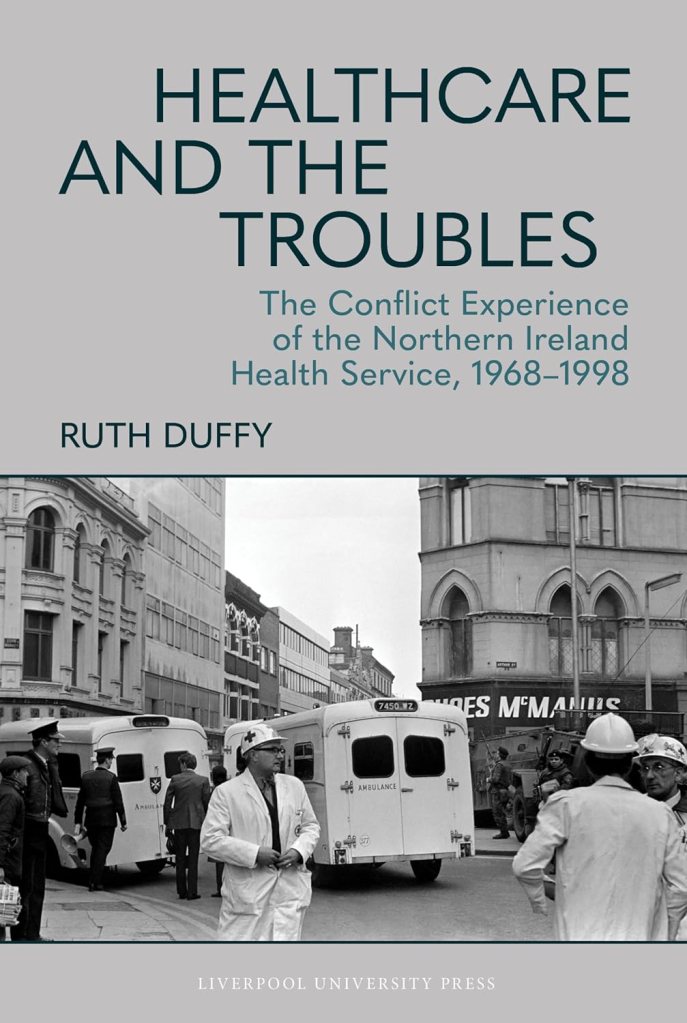
Ruth Duffy, Healthcare and the Troubles: The Conflict Experience of the Northern Ireland Health Service, 1968-1998 (Liverpool UP, 2024)

Welcome on behalf of Institute of Irish Studies to this afternoon’s book launch of Ruth Duffy’s, Healthcare and the Troubles: The Conflict Experience of the Northern Ireland Health Service, 1968-1998. It’s my honour and great pleasure to be able to introduce this important a timely new book to you and suggest why I believe it will make such a significant contribution to our understanding of the period of civil conflict we label the NI Troubles.

It’s unnecessary to remind an audience here in Belfast of the traumatic impact of our conflict that stretched over three decades from the Civil Rights marches of 1968 to the Good Friday Agreement and Omagh bombing of 1998, and which continues to cast a long shadow of unresolved legacy issue to the present. Political violence took 3700 lives and, at a conservative estimate, left over 40,000 physically injured, in a small society in which atrocity and counter-atrocity was intimate and neighbourly, a security infrastructure was pervasive and the rhythms of ordinary life disrupted and punctuated by fear and terror.

We of course now have an enormous academic literature on the conflict from multiple disciplinary perspectives. Remarkably, however, given that traumatic death, injury and lasting physical and mental scarring were at the heart of Troubles experience, scholarly discussion of its impact on the health service and its professionals has been minimal. Until now. Ruth Duffy’s new book is the first to offer an overview of how the health service in the north was structured and prepared (or rather unprepared) for the storm that would break in the late 1960s; how it responded to the sudden and extreme upsurge of violence in the following years; how the concepts of medical ‘neutrality’ and ‘impartiality’ and medical ethics more generally were challenged by the upheaval; and how both practitioners and the general public were impacted at the time and retrospectively by the stresses and traumas of violence and its legacies. To address the challenge, she has adopted complementary historical methods, working patiently through the ministerial records and reports concentrated in PRONI, press coverage over an extended period, and added a series of structured oral history interviews with medical staff from hospitals and community practices across the province.

The devolution of health policy to the Northern Ireland government from 1921 meant that the history of health provision, and from 1948 of the NHS, in the north overlaps with but was never identical to the rest of the UK (which may explain its omission from many general histories of the NHS). Throughout the 20th century, NI tended to top the tables for indicators of poor public health, interconnected with its high levels of structural inequality, poverty and substandard housing. These underlying challenges, combined with the absence of effective planning for the sort of civil emergency that would manifest from August 1969 meant its health institutions were already under significant strain when that happened. With limited additional funding until 1972 it was remarkable that the system coped at all, due largely to the dedication and commitment of its health professionals.

The book does not shy away from the profound problems of a medical system maintaining a real and perceived ‘neutrality’ amid conditions of acute communal polarisation and struggles for control of physical space. These posed major challenges to both the aspirations to maintain medical ‘immunity’ from violence and ‘impartiality’ in the provision of care under conditions of insurgency. Nominally medical provision should be legally protected under the Geneva conventions, but in NI conditions this was virtually a dead letter. Ruth draws attention to episodes where medical ‘immunity’ was not respected involving several IRA murders of NHS staff on hospital property, with the victims being part-time or former security force personnel, as well as several sectarian attacks by loyalists on staff and patients. While these were exceptional, a number of attacks on security force personnel (including bombings) in and around the hospital estate unquestionably placed patients and staff in real danger, and indicated, she observes, a lack of respect for medical immunity. On the other hand, the presence of military personnel at highly sensitive locations, especially Belfast’s Royal Victoria Hospital (RVH), on what were alleged to be surveillance operations drew allegations that the site had been ‘militarised’ and hence a ‘legitimate target’. The impartiality of the NHS was further compromised by a legal requirement from 1967 for staff to report treatments for gunshot and explosives injuries to the RUC, a stipulation that drew political protests and a practice of transferring injured republican paramilitaries across the border for treatment (sometimes with fatal consequences).

Despite these massive violations, and the added problem that in the early years of the Troubles the senior ranks of the service (although not its nursing and ancillary staff) was (and was seen as) disproportionately Protestant, it appears clear that most staff placed a high value on assuring impartial treatment of all victims, irrespective of communal identity and victim/perpetrator status, and of sometimes having to repress personal feelings in doing so. Nevertheless, the fear of attending certain sites and wider sectarianism in the community did lead to the need to duplicate services between hospitals, especially in Belfast.

More acute ethical questions were posed for medical staff engaging more directly with the state through the criminal justice and prison systems. The introduction of internment in 1971 drew allegations of system mistreatment generally and especially of a selected number of internees subjected to ‘deep interrogation’. Doctors asked to examine such detainees were faced with the choice of speaking out over state abuses or engaging in complicity through silence, and the book traces evidence for both options, noting that communal identity was a poor indicator of what choice would be taken. Public complaints from medical professionals such as Dr Patrick Lane and later the police Surgeons Association would be taken up by inquiries and ultimately feed into the discussions that led to the 1975 World Medical Association ‘Tokyo Declaration’ which sought to prohibit professional involvement in or condoning torture or degrading treatment of detainees and prisoners. Similar controversies were stoked by the use as riot control agents of CS Gas and rubber and plastic baton rounds, the latter criticised by four surgeons at the RVH as early as 1972 in a report first suppressed and then ignored by the government.

As the prison estate expanded rapidly in the 1970s-80s and became the site of major confrontations between paramilitary prisoners and the prison authorities, it was again inevitable that the medical profession was drawn in to what Ruth describes as a ‘dual loyalty challenge’. If early charges of selective negligence may have been largely politically motivated, the escalation of systematic protests in NI prisons from 1976 heighted tensions. The mandating of forced baths on health ground by prison doctors during the dirty protest was regarded as collusion with the state. The onset of hunger strikes in 1980 and 1981 (following earlier episodes in jails in GB) attracted sustained debates between professionals on the medical ethics of permitting death by starvation as opposed to coerced force-feeding. In the end this tactic was not adopted in NI, and the humane treatment of hunger striking prisoners by the prison medical staff, led by Dr David Ross, appears to have assuaged much of the previous hostility. Ross’s suicide in 1986, linked to his experience of overseeing the ten deaths in the Maze in 1981, might be regarded as another outcome of the hunger strikes.

If treatment of the belligerents of the Troubles was the most direct and complex way in which the conflict impacted on the NHS, it was merely the tip of the iceberg. The sustained disruption of society, often concentrated in and around major urban hospital sites such as the RVH, Musgrave Park and the Mater, complicated the day to day lives of health staff and ordinary patients alike; and this extended beyond to the work of ambulance staff, GPs and community health workers. Financially, the additional cost of acute and trauma treatment placed a huge burden on the regional NHS, with the budget rising from under £60m in 1972/3 to £1.2b by 1992/3. While much of this could be leveraged (albeit often with delays) from the UK government, it also meant transfer of resources within the service towards A and E and ICU provision and away from ‘ordinary’ chronic treatment and the patients who depended on these. Duplication for reasons already mentioned also imposed additional costs, as did extended building disruption, as with the Belfast City Hospital Tower Block through the 1970s.

Moving on to legacies, Ruth weighs up the evidence for the ‘war is good for medicine’ thesis, as it related to NI. Certainly, some areas of treatment received boosts from investment in research and equipment rendered most in demand under Troubles conditions. Medical specialisms relating to traumatic injuries, including in the plastic, thoracic, neurosurgery and microsurgery fields, became evident, especially at the RVH and Ulster Hospital. Demand for physical trauma treatment did not end in 1998, with the continuing frequency of paramilitary punishment attacks maintaining need for extensive orthopaedic and rehabilitation care.

Set against this has been a reluctance to commit funding to long-term physical rehabilitation and above all to mental health care. Only very late in the Troubles, with the Omagh bombing of 1998, was mental health consequences of violent trauma given proper consideration, but tis remains a woefully underfunded element of health spending in NI. A 2015 report found that 60% of all mental health problems associated with the Troubles had not received treatment, while for many others it was substandard, and that this was manifest in the very high levels of suicides with Troubles connections, at a rate well above UK averages.

Mental health issues relate not only to victims and their relatives, but also to medical staff who had worked in the period, many of whom had sought to maintain high levels of neutrality despite witnessing scenes of extreme horror links with symptoms of PTSD. In the absence of mental health supports such staff had been dependent on camaraderie and team-work spirit to maintain resilience, although the long-terms costs of such normalising strategies may have been underestimated.

Summing up, this is a really important book, shifting attention away from the self-promotion and apologetics of belligerents and state and party-political actors towards a focus on the consequences of sustained civil conflict on an essential part of civil society.

It deals with both bureaucratic resource allocations and acts of harrowing violence, with the ethical dilemmas of medical professionals caught between state obligations and conscience, and with the coping mechanisms (often featuring humour) of the ordinary workers who did so much to keep society functioning at a time when so much appears to be falling into an abyss of sectarianism and carnage. I recommend it to you all most strongly.

Peter Gray (QUB)

4.11.24

William Sharman Crawford and Ulster Radicalism wins ACIS Book Prize

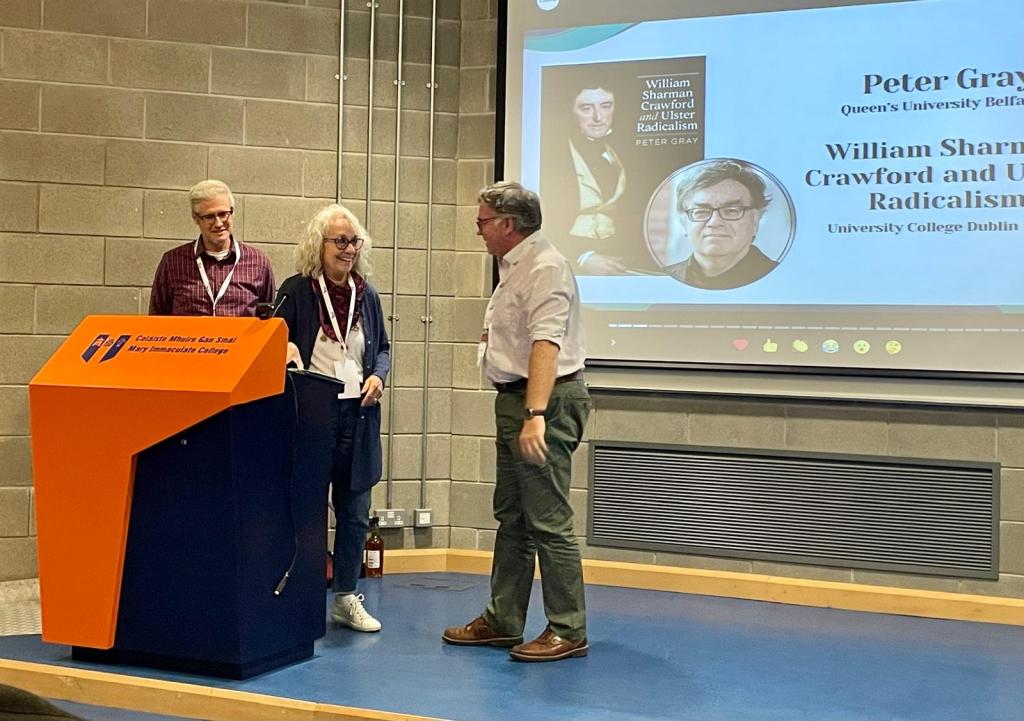
The American Conference for Irish Studies 2023 James S. Donnelly Sr Prize for Best Book on History and Social Science, was awarded to Peter Gray for William Sharman Crawford and Ulster Radicalism (UCD Press, 2023), at the ACIS National Conference, Mary Immaculate College, Limerick, 21 June 2024.

The committee noted: ‘It was so refreshing to be introduced to a 19th-century Ulster landowner with such a sense of moral rectitude, best summed up overall by Gray’s concluding sentence: ‘Sharman Crawford’s was a radical political life worthy of modern attention’ (367). He proved that point admirably and cohesively in a beautifully written biography steeped in research, much of it difficult to come by. Moreover, his book is redolent with vital factual information about conditions in Ireland, primarily in Ulster, but also, beyond, that were germane to the life and career of Sharman Crawford. In the process, he completely justifies his decision to pursue “a four generational approach” to his subject (5). Overall, Gray uses biography to explain the evolution of Irish patriotic movements more broadly and reflect on heterogeneous strands in those movements that were increasingly subsumed as Irish nationalism evolved into the later 19th and 20th century. The person of Crawford is used as a way to push back against dichotomous and largely 20th century visions of Irish nationalism as fundamentally Catholic. He is also used as a way to explore the influence of radical international intellectual movements on Irish politics.’

https://www.ucdpress.ie/page/detail/william-sharman-crawford/?k=9781910820438

William Sharman Crawford and Ulster Radicalism

William Sharman Crawford and Ulster Radicalism is published in November 2023 by University College Dublin Press (ISBN 9781910820438, 468pp).

William Sharman Crawford (1780‐1861) was the leading agrarian and democratic radical active in Ulster politics between the early 1830s and the 1850s. William Sharman Crawford and Ulster Radicalism is the first full biography of his life.

It places his life and ideas in the context of the development of radical liberalism in the province over a more extended period, from his father’s involvement in the Volunteers in the era of the American and French revolutions, through William’s own leadership roles in Irish and British radical reform movements, including the Repeal Association, Chartism, and the Tenant League. It explores his attempts to reconcile Irish patriotism with the existence of the Union through the concept of ‘Federalism’, his efforts to act as an ‘ideal landlord’ in the face of agrarian unrest and famine, and his deep commitment to attaining land and welfare reforms that he believed would empower both tenant farmers and the labouring poor.

William Sharman Crawford and Ulster Radicalism traces the legacy of his politics through the political careers of his children James in Gladstonian liberalism and Mabel in the women’s suffrage movement, both of whom sought, in common with Presbyterian allies such as James McKnight, to carry his ideas into the later nineteenth century. It concludes with the collapse of the family’s radical tradition in the following generation, as his grandson Robert Gordon came to reject liberal unionism and take an active role in the Ulster Unionist movement from the 1890s.

Through an assessment of the Sharman Crawford family over four generations, William Sharman Crawford and Ulster Radicalism explores the resilience of the Ulster Protestant radical tradition in the wake of the setbacks of 1798, its strengths and weaknesses, and its relations with Irish Catholic nationalism, British radicalism, the conservative landed, and Orange traditions within Ulster.

READ THE INTRODUCTION:

Booklaunch: Irish Studies Seminar series, 11 December 2023, 4.30pm, in Lanyon 0G/074, Queen’s University Belfast. All welcome.

Book Review: R.J.C. Adams, Shadow of a Taxman

R.J.C. Adams, Shadow of a Taxman: Who Funded the Irish Revolution?

Oxford University Press, 2022

Its perhaps no surprise that the historiography of the Irish Revolution of 1916-21, like that of most revolutions (whether successful or not) is dominated by the revolutionary man (or woman) of action – the heroic or demonised wielders of weapons or manifestoes. Yet, as Robin Adams reminds us in his important new book, few revolutions stand much chance of success without funding, both to pay for those weapons and to maintain the revolutionary counter-state its adherents project in place of the old political order. So while, in Sean O’Casey’s famous phrase, the ‘shadow of the gunman’ always hangs over any account of the successful challenge to British rule, we need to understand also not just the ‘shadow of the taxman’ (personified in the alter ego of Michael Collins as the supremely talented Minister of Finance of Dail Eireann), but the team of committed fundraisers who worked in Ireland and overseas to make that Dail a reality, and the hundreds of thousands who placed not only their faith, but their hard cash into what was in 1919-21 still only the shadow of an independent Irish state.

The story is one with a lengthy historical hinterland, efficiently sketched and drawing on previous work by Michael Keyes, Niall Whelehan and others. Like much else in modern Irish political culture, mass fundraising at home and abroad was developed by Daniel O’Connell, and pursued both by his constitutionalist followers (both Parnell and Redmond undertook fundraising tours in the US) and by the revolutionary underground of the IRB, the Fenian Brotherhood, and their splinter groups. Yet never before or since has Irish political fundraising approached the scale and sophistication seen in the work of the Dail Finance Department and its envoys between 1919 and 1921 – justifying Adams’ description of the event as a ‘crowd-funded’ revolution, arising out of a strategy of necessity but providing added advantages from mass civilian participation and the sense of political legitimacy arising from that.

Like so much relating to the revolution, the First World War paved the way – not just in giving rise to mass-membership radical nationalist movements in the shape of the Sinn Fein party in Ireland and its allied Friends of Irish Freedom in the US, but in making war funding through low denomination bond issues widely known on both sides of the Atlantic and stimulating funding drives to support the internees of 1916 and to support the anti-conscription campaign in 1918. Crucially the latter had seen the adherence of large numbers of senior as well as junior Catholic clergy, most of whom came (in sharp contrast to their predecessors in the Fenian era) to endorse Sinn Fein and the legitimacy of Dail Eireann as the true government of Ireland by January 1919. As Adams makes evidently clear, this clerical endorsement was crucial to the success of the fund-raising drives that followed.

The book takes us through the origins of the key innovation of the Dáil Department of Finance under Collins – the use of national loans raised through the issue of small denomination bonds, repayable if and when the state was formally established following a hoped-for British withdrawal. Given the state’s active antagonism to the bond drive (including press censorship, arrests of canvassers and raids on Dail offices and friendly banks), this took some ingenuity, subterfuge and high levels of local and national organisation – and included actions ranging from fiscal evasion (such as the secreting of some funds in co-operative society accounts in northern England) to direction (such as the assassination of the investigating magistrate Alan Bell when he got too close to sequestering ‘Michael Collins’ war chest’ in March 1920. ‘Soft coercion’ of some less willing Irish contributors cannot be ruled out, but the book stresses the concern of the campaign to acquire the ‘respectability’ of an established state mechanism and the evident enthusiasm of the great majority of the 140,000 subscribers in Ireland (raising £372,000 by July 1920), despite the high risk of never seeing any financial return. One of the most important aspects of this book is the analysis made from surviving regional records of the social profile of these contributers.

Raising funds for the Dail in the US was both easier and more complicated than in Ireland. The fund-raising drive there, issuing ‘bond certificates’ to keep within US law, and led by Harry Boland and James O’Mara, had the advantage of an absence of official persecution, well-established Irish-American diasporic political networks and from May 1919 the presence in the states of Eamon De Valera, president of the putative Irish Republic, around whom a high-profile national campaign could be launched in 1920. The main problem here lay in the very pre-eminence of a centralised Irish-American body, the Friends of Irish Freedom, led by Daniel Cohalan and intimately linked to the venerable John Devoy and his Clan na Gael organisation (whose activities in Irish politics stretched back to the New Departure agreed with Parnell in 1879 and which effectively funded the Land War and the subsequent rise of the Home Rule Party). Often preoccupied with US political concerns, these clashed openly with De Valera, who was anxious to assert the supremacy of Dail authority. These conflicts threatened to disrupt the American campaign, but in the end De Valera and his associates surpassed their expectations, raising over five million dollars from 276,000 donors, the largest amount ever raised for an Irish cause in America.

Parallel campaigns in Australia, Canada and Argentina proved much less successful, but as with the domestic, the records of American contributors reveal, under Adams’ careful analysis, much about the nature and dynamics of this community. Interestingly, the number of women donors in the US was much higher than in Ireland itself (giving rise to hostile British commentary on the behaviour of Irish ‘bridgets’) and although 90% of donations came from the Irish-born or those of Irish parentage, the American bond campaign created opportunities for some internationalist co-operation with others campaigning for African-American rights, European nationalists and Jewish Zionists.

The December 1921 Treaty cut short a second External National Loan campaign in the US and its organisers returned home to take opposite sides in the ensuing Civil War (with a rush to seize control over any remaining US funds). Nevertheless, as the book clearly demonstrates, the revolutionary fundraising drives, launched under adverse circumstances,  had exceeded expectations and provided the funding that made Irish independence possible. So clearly had De Valera learned the lesson that he focused in 1927 on an American fundraising tour that would meet the bulk of the costs of his new Fianna Fail party and its Irish Press newspaper.

This book will I am sure make a significant contribution to the literature on the revolutionary era, not least through its careful and determined pursuit of the financial thread that ran beneath so much of the headline upheaval of the era. In addition to the plenitude of statistics one would expect of a winner of the Economic History Society’s Thirsk-Feinstein prize for best dissertation, here are many humanistic details to savour here – the clash with the Ulster Unionist delegation undermining De Valera’s Dixie tour with anti-Catholic theology in 1920, the Argentine donkey ‘Saoirse’ that was sold 47 times in one day for Dail Eireann funds, the rival pursuit of the celebrity endorsement of the singing sensation  Count John McCormack for Irish collections in 1921. It’s a concise and accessible read on a complex subject and deserves a wide audience.

Peter Gray, Booklaunch address, 31 Oct. 2022.

Baron Eötvös and Count Strzelecki in Ireland: Poverty and Famine, 1837-49

Delighted to have had the opportunity to speak about two extraordinary European travellers to Ireland, Baron Jozsef Eötvös in 1837 and County Paul Strzelecki in 1847-9, at Stormont on 25 November 2021. Thanks to the Consulates of Poland and Hungary and Claire Sugden for hosting, and to Maciek Bator and Ken Belshaw for organising.

The powerpoint presentation can be downloaded here: